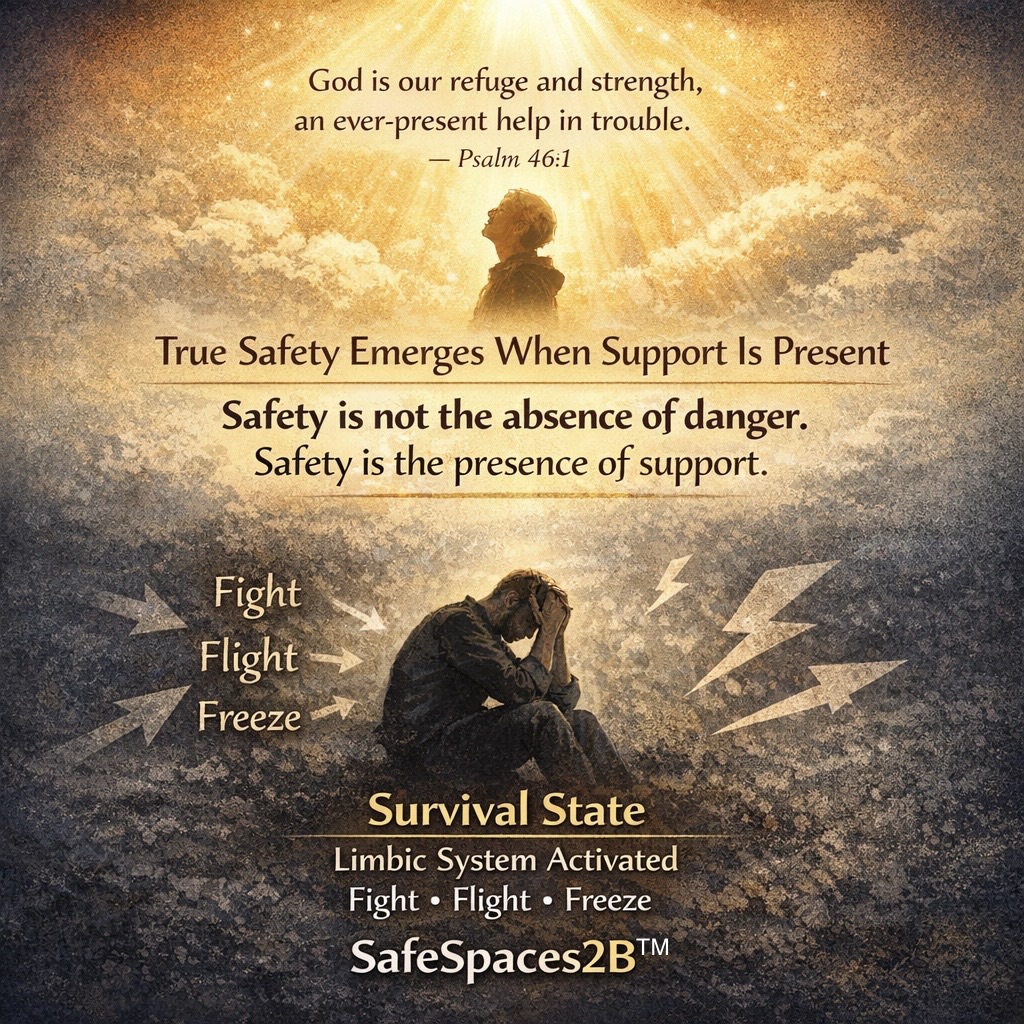
Many people believe feeling safe means there is no threat around them. But the nervous system tells a different story.
Safety is not created simply because danger disappears. Safety is created when support is present.
Your brain is constantly scanning your environment through what neuroscientists call neuroception—an automatic process asking one question:
Am I safe enough right now?
When the answer is no, the limbic system activates survival responses: • Fight • Flight • Freeze
And here’s what we often miss, the nervous system doesn’t exit these states just because the threat is gone. It needs signals of safety.
Signals like: • Supportive relationships • A regulating environment • Compassion toward ourselves • Being seen and understood • Connection with God
“God is our refuge and strength, an ever present help in trouble.” (Psalm 46:1, NIV)
These cues help the nervous system return to a place of regulation—what neuroscience calls the ventral vagal state: the space of connection, creativity, healing, and rest.
So we reframe:
Safety is not the absence of danger. Safety is the presence of support.
And sometimes, the most powerful shift begins when we learn to offer ourselves the same compassion God has always extended to us.